



Stephen
New research from ChooseMyCar.com reveals that risky driving habits are more common than we think, with most drivers unaware that these regular tendencies are illegal – and potentially dangerous.
For this reason, it’s important to understand the rules – and fines – that are in place. According to an expert from ChooseMyCar.com, the UK’s leading marketplace, a clear understanding of the rules is what is needed to keep roads safe. Habits that may seem harmless are classed as illegal, such as snacking on a burger behind the wheel, setting off with an icy windscreen, or ditching the shoes for barefoot driving.
A recent survey by ChooseMyCar.com revealed that 18 per cent of Brits admit to wearing flip flops in the car while driving, with 13 per cent going completely barefoot. The most common risky habit was eating and driving, which 42 per cent of Brits admit to doing. Driving while snacking, sandy or bare feet can all land you a £100 fine and three penalty points.
The research also found that 30 per cent of Brits have been in a road rage incident, whether it was a physical or verbal altercation, an offence that could land them a £1,000 fine and three points. Similarly, 21 per cent of Brits admitted to having a dirty number plate when driving, another offence that results in a £1,000 fine and three penalty points.
More serious offences were confessed by 30 per cent of Brits, who admit to accepting petrol money from friends and family, which results in a £2,500 fine and up to six points, as it essentially means you’re driving an unlicensed taxi service when making a profit.
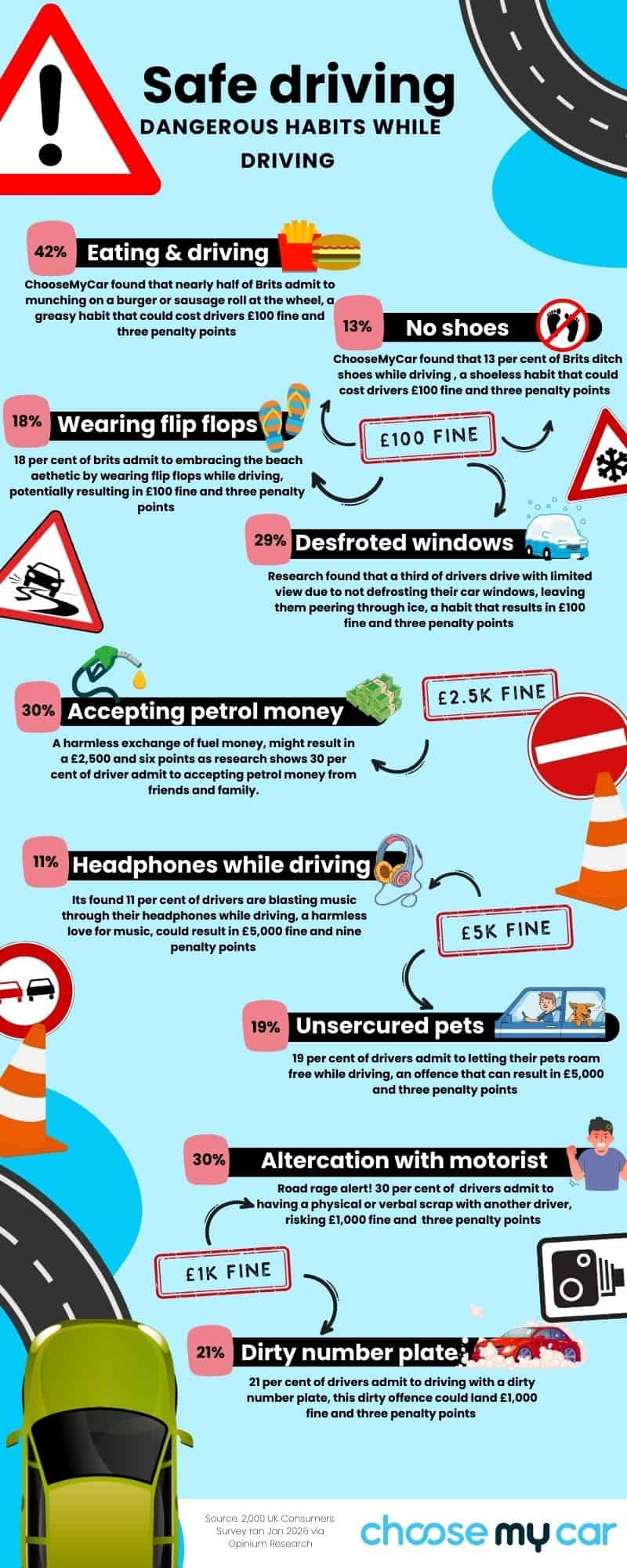
Some of the riskier offences carry the highest fines, such as 11 per cent of Brits admit to listening to loud music through headphones while driving, which can distract drivers from sounds and hazards inside and outside the vehicle. Nineteen per cent of Brits admit to failing to secure their pet properly within their car, meaning they roam freely while driving. Both of these offences result in a £5,000 fine and up to nine points, but they aren’t just illegal, they are seriously dangerous for yourself and other drivers.
Nick Zapolski, motoring expert and founder of ChooseMyCar.com, said it’s essential that Brits don’t fall into these bad habits, to keep themselves – and others – safe on the road..
“Driving is a necessity for millions of Brits, so it’s easy to forget that we’re operating a two-tonne piece of metal that can cause serious damage if we’re not careful. And it doesn’t help that millions of drivers are still guilty of some quite frankly shocking habits.
“Phone use, eating while driving, driving in flip flops during the summer months or leaving your pet to roam free on the back seat. They won’t just lead to a potential run-in with the police, they’re genuinely dangerous and can lead to congestion, sudden swerving, or even serious crashes. It’s a good job, though, that these habits are very easy to break.”
So what else is bad on the road? The team at ChooseMyCar also reveal some of the worst driving habits – and how to beat them
Driving while tired
Although driving while tired may not seem as risky as other bad habits, such as drunk driving, it’s statistically more dangerous. And yet, over a third (38 per cent) of Brits have admitted to doing it. Like drunk driving, it significantly reduces your road awareness, leading to a lost control of your car, or even a fatal crash. If you’re feeling really tired, the best thing to do is avoid driving completely until after you’ve had some rest. However, if driving is really unavoidable, make sure to stop for plenty of breaks while on your journey.
Mobile phone use
While using a phone on the road is known to be dangerous and illegal (£200 fines and driving bans are often issued), a 2025 study revealed that nearly half (43 per cent) of ‘young drivers’ (ages 17-24) admitted to reading or replying to a text message while behind the wheel. However, this bad habit makes you four times as likely to be involved in a car crash. For this reason, you should not use your phone in any way while driving – hands-free phone usage is still dangerous. If you’re worried about missing important calls or texts, make them all before your journey, or inform others that you are driving and will be unable to answer your phone.
Driving the morning after drinking
Although driving while drunk is known to be dangerous, driving the morning after drinking appears to be a more grey area, with nearly a quarter (23 per cent) of Brits admitting to driving the following morning after drinking, and being worried they were over the limit. Even if you haven’t drank since the night before, there’s a good chance you’re still over the limit, particularly if you’re feeling especially groggy. Put simply, if you can afford a night out, you can afford a cab home, regardless of the hour.
Not indicating
Indicating when driving is vital for road safety, but yet nearly two-thirds of UK road users (63 per cent) have had to suddenly brake because another driver didn’t indicate. This is a very bad habit, as it doesn’t warn drivers of what you intend to do next. As a result, this can lead to sudden braking, swerving, collisions, or even serious crashes. To stop this happening, make sure to signal in good time when you need to, although not too early to avoid accidentally confusing other drivers. You must also check your indicators regularly, to ensure they don’t stop working when you’re on a long journey.
Tailgating
Tailgating appears to be an increasing issue on British roads, with a 2025 report reading that over half (55 per cent) of UK drivers felt it had been getting worse over previous years. And, as well as it being annoying, it’s also a huge road risk. The two-second gap exists to help give you enough time to slow down or stop if needed – anything less greatly increases the chances of an accident. If you’re unsure how to measure the two-second gap while behind the wheel, choose a static object, such as a tree. When the car in front of you drives past, say to yourself “only a fool breaks the two-second rule.” If you drive past the object before you finish this sentence, you’re driving too close to the car in front of you.
Not wearing a seat belt
Although seatbelts have been mandatory for all drivers for 43 years, shockingly, a 2021 study revealed that over two million drivers were observed not wearing a seatbelt. Unsurprisingly, 2024 data reveals that a quarter (24 per cent) of people who die on roads are not wearing seatbelts. If you want to avoid serious injuries in a crash, or even death, wear your seatbelt at all times when on the road.
Driving in the wrong lane
Middle-lane hogging is a well-known annoying habit which hasn’t seemed to go away, with nearly half (43 per cent) of drivers admitting to driving in the middle lane even when the inside lane is clear. And shockingly, only 51 per cent are aware that this can result in an offence, usually an on-the-spot £100 fine and three points. It’s not just irritating, it can cause huge problems, such as congestion and undertaking. For this reason, changing lanes, even if it seems scary, is a necessary manoeuvre that every driver must follow.
Driving through puddles
Rainfall is expected to continue this month, and this will likely mean that puddles on our roads will appear. But, even though it can be hard to avoid puddles while driving, splashing pedestrians – even if it’s an accident – is not only annoying for the pedestrians, it’s also an offence. According to section three of the Road Traffic Act 1988, this habit, which falls under careless driving, could land you a fine of up to £5,000, as well as being taken to court. If you’re approaching a puddle and it’s unavoidable, slow down and assess its depth, before driving through it slowly in second gear.